Resources & Further Viewing
// Every voice and cited source on this site carries a reputability score, 0–10, rolled up from four criteria: authority on the topic, evidence quality, track record, and independence. Hover or tap any score for the breakdown and the reasoning. Scores are ours, argued openly, and revised when the evidence changes.
// Primary Sources
- Direct Stimulus Payments to Individuals. Claudia Sahm, The Hamilton Project, 2019. The origin of the trigger and payment design this spec adopts. Vetted 9/10
- Recession Ready: Fiscal Policies to Stabilize the American Economy. Boushey, Nunn & Shambaugh (eds.), Hamilton Project / Washington Center for Equitable Growth, 2019. The full policy volume on automatic stabilizer design. Vetted 8/10
- Economic Downturns: Considerations for an Effective Automatic Fiscal Response. US Government Accountability Office, 2025. The nonpartisan design criteria: timely, temporary, targeted, predictable. Vetted 10/10
- Effects of Automatic Stabilizers on the Federal Budget: 2024 to 2034. Congressional Budget Office, 2024. What existing stabilizers actually did in 2009–2021, in numbers. Vetted 10/10
- Stimulus Checks: Direct Payments to Individuals during the COVID-19 Pandemic. US Government Accountability Office, 2022. $931B to ~165M people: the proof the delivery rails work. Vetted 10/10
// Evidence & Counterargument
- Why Is U.S. Inflation Higher than in Other Countries?. Jordà, Liu, Nechio & Rivera-Reyes, SF Fed Economic Letter, 2022. The strongest quantified version of the overstimulus critique. Vetted 9/10
- The Extended Benefits Trigger Failure. Economic Policy Institute. Why badly designed triggers don't fire: the cautionary tale for this bill. Vetted 7/10
- The Structural Balance Rule in Chile: Ten Years, Ten Lessons. Mario Marcel, Inter-American Development Bank. The decade-long test of rules-based counter-cyclical fiscal policy. Vetted 9/10
- Lessons Learned When the Pandemic Led to Rapidly Rising Unemployment Claims. GAO. The 2020 state UI collapse: why delivery infrastructure is part of the bill. Vetted 9/10
- Lessons Learned from Economic Impact Payments during COVID-19. Brookings. Keep the IRS rails warm in peacetime. Vetted 8/10
// Further Viewing

Khan Academy Vetted 9/10
The cleanest plain-language explanation of how taxes and transfers already expand and contract without a new vote. It's the foundation this bill builds on.
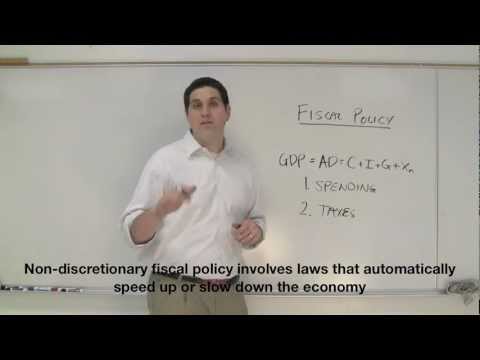
ACDC Econ Vetted 8/10
Three minutes on discretionary versus automatic fiscal policy, the distinction this entire bill turns on.
Version history: v0.1: first public draft. v0.2: source reputability scores added. v0.3: vetting expanded to a four-criteria rubric, July 16, 2026. Revisions will be visible here.